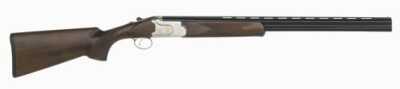
Our Reserve Series™ shotguns are beauties, but don't let the good looks fool you. These over-and-unders work as hard as you and your four-legged hunting buddy do. These double guns share the same classic lines, craftsmanship and reliability associated with so-called "high end" over-and-unders. What's missing is the high-end price tag. That's right, Reserve Series™ shotguns are as easy to afford as they are to admire. At the heart of these amazing over-and-unders: an underlock design box-lock action for superior strength and low profile. In plain English, the barrels are set lower in the receiver and in closer alignment to your arms and hands. Shoulder your Reserve Series™, and you're instinctively on target. In the unlikely event that's not enough to bag your bird, chrome-plated bores are topped with a wide, ventilated rib, putting your eye square on that streaking target. No question the Reserve Series™ is a sight to see, but the beauty of these shotguns is more than skin-deep. Precision machining keeps the action completely closed - dirt and debris doesn't get into the receiver, reducing wear and maintenance, while manual extractors provide a smooth, effortless operation of the action. Precision-made, easy to handle and just as easy on the eyes, the Reserve Series™ provides an outstanding over-and-under at an outstanding price.
The information below comes from our Gun Caliber Dictionary and is for
general reference only. It does not describe the specifications of this
particular item.
The 28 gauge was introduced in 1903 by Parker Brothers, famous for double-barrel shotguns. With a nominal bore diameter of .550-inch, it is considered a "small gauge" shotgun, and 28 gauge is one of the four officlal events in American skeet. Case length is 2 3/4 inches and the standard charge is just 3/4-ounce of shot. That said, with modern shells the 28 gauge is surprisingly effective on both clay targets and upland birds. Although definitely an "expert's shotgun," the 28 gauge has the advantage of low recoil, can be built into very light shotguns, and is much more effective than the .410. Over the years it was kept alive mostly by serious skeet shooters, but today is often chosen by serious upland bird hunters. Because of pellet count it is most effective with smaller shot sizes (7 1/2, 8, and 9), so is rarely employed by waterfowlers.
—
Craig Boddington