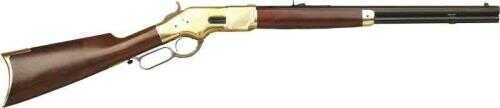
Cimarron 1866 Yellowboy Sporting Rifle 24" Barrel .44 WCF
Originally known as the "Improved Henry" due to its patented loading gate on the side of the frame, designed by Nelson King, Winchester's plant superintendent, and the addition of a wood forearm, the 1866 model was known as the "Yellow Boy" by the Native Americans, because of its brass frame. The '66 model was the first true cowboy lever-action and the first that adapted well to carrying in a saddle scabbard, due to its slab sided design. With over 170,000 made between 1866-1898--it's popularity continued long after more powerful lever guns were introduced. The '66 model was famous worldwide, with guns used by the forces of Benito Juarez in Mexico, the Turkish army in their fight against the Russians and in the Wild West by such notables as Sioux Medicine Man Sitting Bull, the Union Pacific's chief engineer, General Grenville Dodge, and desperado Bill Doolin. Cimarron offers several 1866 Yellowboys, such as the 24-inch barreled Sporting Rifle, a 20-inch Short Rifle (both of these models sport octagon barrels), round barreled carbines including the 19-inch saddle ring carbine, a brass tack-decorated 19-inch Indian carbine, and a 16-inch Trapper model. Calibers available include .45 Colt, .44-40, .44 Special, .38 Special, .38-40, .32-20 and .22 Long Rifle, and with finishes like the Standard Blue, Charcoal Blue, or Original Finish, depending on which model you select. One of Cimarron's true, handsome Old West classics!
Sku Ca232
Caliber 44 WCF
Style Sporting Rifle
Capacity 12 Rnds.
Frame Brass
Finish Standard Blue
Stock/Forearm Walnut
Overall Length N/A
Weight 8.26 Lbs.
The information below comes from our Gun Caliber Dictionary and is for
general reference only. It does not describe the specifications of this
particular item.
The 44-40 Winchester (44 WCF) was introduced by Winchester in 1873 in their Model 1873 lever action. The '73, "the gun that won the West," was the first truly successful repeater, and its 44-40 cartridge was quickly adopted by other manufacturers, including both Colt and Smith & Wesson in revolvers. Using a .427-inch bullet, the standard load features a 200-grain bullet at about 1100 feet per second, producing 588 foot-pounds of energy. This is not a lot of power, but the 44-40 was probaby the most popular sporting cartridge of the 19th Century, accounting for untold amounts of game. It remained the most popular chambering in the 1892 Winchester, and was a common chambering in both rifles and handguns at least through the 1940s. The growth in Cowboy Action shooting has revived it; the 44-40 has less recoil than the 45 Colt, and serves as a common chambering for rifles and revolvers. Ammo is readily available and it is chambered to numerous reissues and reproductions.
—
Craig Boddington