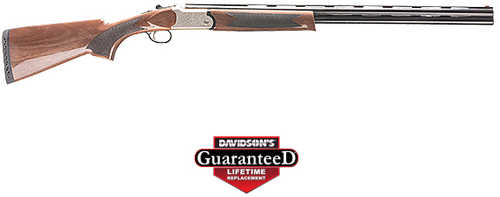
General Description: 3” Chamber Over and Under. The Hunter features a solid frame for durability and strength, sealed actions to keep dirt out, self-adjusting locking lugs, top tang barrel selector and safety, and steel mono-block barrel construction and Turkish Walnut with semi-gloss finish. Comes with 5 interchangeable Beretta®/Benelli® Mobil style choke tubes (SK, IC, M, IM, F), choke box and choke wrench. Rubber recoil pad and backed with a five year mechanical warranty.
Features : • Extractors
• Vent Top and Mid Rib
• Fiber Optic Sight
• Single Selective Trigger
• Chrome-lined Chamber and Barrel
• Acid Etched Receiver
• Turkish Walnut Stock and Forearm
• 5 Beretta®/Benelli® Mobil Style Choke Tubes (SK, IC, M, IM, F)
Caliber: 20 Gauge
Finish: High Polished Blue
Action: Over & Under
Stock: Walnut, High Gloss
Sight: FT: Fiber Optic
Barrel Length: 28
Overall Length: 45.5
Weight: 6 lbs
Capacity: 2
Safety: Top Tang Safety
Receiver: Silver
Chamber: 3
The information below comes from our Gun Caliber Dictionary and is for
general reference only. It does not describe the specifications of this
particular item.
The 20-gauge follows the 12-gauge as America's second-most popular shotgun gauge. And, with modern shotshells, continues to gain ground. The 20-gauge has a bore diameter of .615-inch, with modern shells in either 2 3/4 "standard" or 3-inch "magnum" length. Most modern shotguns are chambered to handle both. Payloads vary from light-recoiling 5/8-ounce loads all the way to heavy turkey loads carrying 1 5/16 ounces of shot. Standard 2 3/4" loads for targets and upland birds are normally 7/8 or one ounce. At its very best the 20-gauge does not have the capability of a 12-gauge...but with modern shot, wad columns, and chokes it doesn't give up much, and it can be built into a much lighter shotgun developing less recoil. Virtually all manufacturers offer 20-gauge guns, and they are available in all action types and for virtually all shotgunning sports. The 20-gauge joins the 12, 28, and .410 as one of four events in skeet competition, and is becoming increasingly popular for sporting clays.
—
Craig Boddington