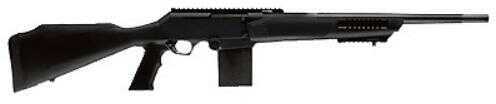
The FNAR puts autoloading and bolt-action accuracy in your hands. Every FNAR rifle must meet a 1 MOA or better accuracy specification, just like the FN SPR precision rifles. The receiver is constructed of aircraft grade alloy for light weight and strength. This fluted barrel is offered in light contour and features a hard chrome lining and recessed target crown for accuracy and long life.
Specifications :
- Caliber: 308 Win./7.26x51mm
- Magazine Capacity: 20
- Barrel Length: 20"
- Overall Length: 41 1/2"
- Length of Pull: 14 1/8"
- Weight: 9 lbs.
- Rate of Twist: 1 turn in 12 "
- Operating Principle: Gas-operated autoloader
- Magazine Type: Detachable Box Magazine
- Stock Finish: Matte Black
- Stock / Grip: Ergonomic adjustable synthetic stock
- Additional Description: Fluted Barrel, Multiple MIL-STD 1913 rails
- Cannot Ship to: CA, Denver CO, Vail CO, HI, Aurora IL, Chicago IL, Franklin Park IL, Oak Park IL,MA, NJ, NY, Cincinnati OH, Columbus OH, Dayton OH, Dublin OH, Shaker Heights OH, Toledo OH, Washinton DC
Light 20Round
The information below comes from our Gun Caliber Dictionary and is for
general reference only. It does not describe the specifications of this
particular item.
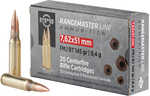
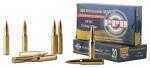
The 7.62X51mm NATO cartridge was adopted by the U.S. in the M14 rifle in 1957. NATO adopted it in the same year, but in other platforms. The 7.62X51mm is essentially a shortened 30-06 case, allowing a more compact action and more compact ammunition at very minor cost in performance. A side benefit--which might not have been anticipated--is improved accuracy because of the greater efficiency of the shorter case. Although 7.62X51mm has been largely supplanted by the 5.56X45mm NATO cartridge in service rifles, it is still widely used by militaries around the world and remains a primary cartridge for light and medium machineguns. Due to its exceptional accuracy it is also a very common cartridge for military sniping at ranges to a bit beyond 1000 yards. The civilian version, the 308 Winchester, was introduced in 1952 while the 7.62X51MM was still in the experimental stages.
—
Craig Boddington