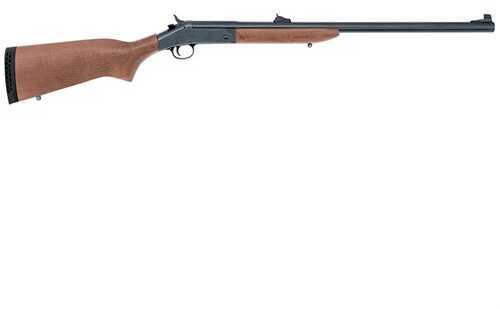
SBI-024 Shotgun 20 Gauge, 24" Barrel, Rifled Bore, 3" Chamber
New England Tracker II Slug Gun. Power, accuracy and affordability have now been brought to the ever-growing slug hunting market. The Tracker II model offers greater accuracy over a conventional shotgun with slugs out to 100 yards. It comes with a list of standard features, which includes fully adjustable rifle sights and a quality recoil pad. It is designed to use sabot style slugs for long-range accuracy, and is effective on game as it is simple to use.
Specifications:
- Action: Break open, side lever release, automatic ejection
- Stock: American hardwood, walnut finish, full pistol grip, recoil pad, sling swivel studs
- Forend: Semi-beavertail, American hardwood, walnut finish
- Sight: Adjustable Rifle sights
- Overall Length: 40"
- Length of Pull: 14"
- Drop at Comb: 1 1/2"
- Drop at Heel: 2 1/8"
- Weight: 5 1/4 Lbs.
- Gauge: 20
- Chamber: 3"
- Barrel: 24"
The information below comes from our Gun Caliber Dictionary and is for
general reference only. It does not describe the specifications of this
particular item.
The 20-gauge follows the 12-gauge as America's second-most popular shotgun gauge. And, with modern shotshells, continues to gain ground. The 20-gauge has a bore diameter of .615-inch, with modern shells in either 2 3/4 "standard" or 3-inch "magnum" length. Most modern shotguns are chambered to handle both. Payloads vary from light-recoiling 5/8-ounce loads all the way to heavy turkey loads carrying 1 5/16 ounces of shot. Standard 2 3/4" loads for targets and upland birds are normally 7/8 or one ounce. At its very best the 20-gauge does not have the capability of a 12-gauge...but with modern shot, wad columns, and chokes it doesn't give up much, and it can be built into a much lighter shotgun developing less recoil. Virtually all manufacturers offer 20-gauge guns, and they are available in all action types and for virtually all shotgunning sports. The 20-gauge joins the 12, 28, and .410 as one of four events in skeet competition, and is becoming increasingly popular for sporting clays.
—
Craig Boddington